
Scale or Agility?
The New Economics of Manufacturing
When it comes to large production, Injection molding is still difficult to beat. Once the mold has been made, the process can produce thousands of identical parts with cycle times of around 15 to 60 seconds. For production volumes of 1,000 to 100,000 parts or more, the cost per part can become very low.
The main drawback comes before production even starts. A traditional metal mold can cost anywhere from around $2,000 to more than $100,000 in Australia, depending on the part and the complexity of the tooling. It can also take four to eight weeks to manufacture.
3D printing takes a different approach. Industrial processes such as Fused Deposition Melting (FDM) and Stereolithography (SLA) do not require dedicated molds or tooling. The cost of producing the first part is therefore much closer to the cost of producing the next one.
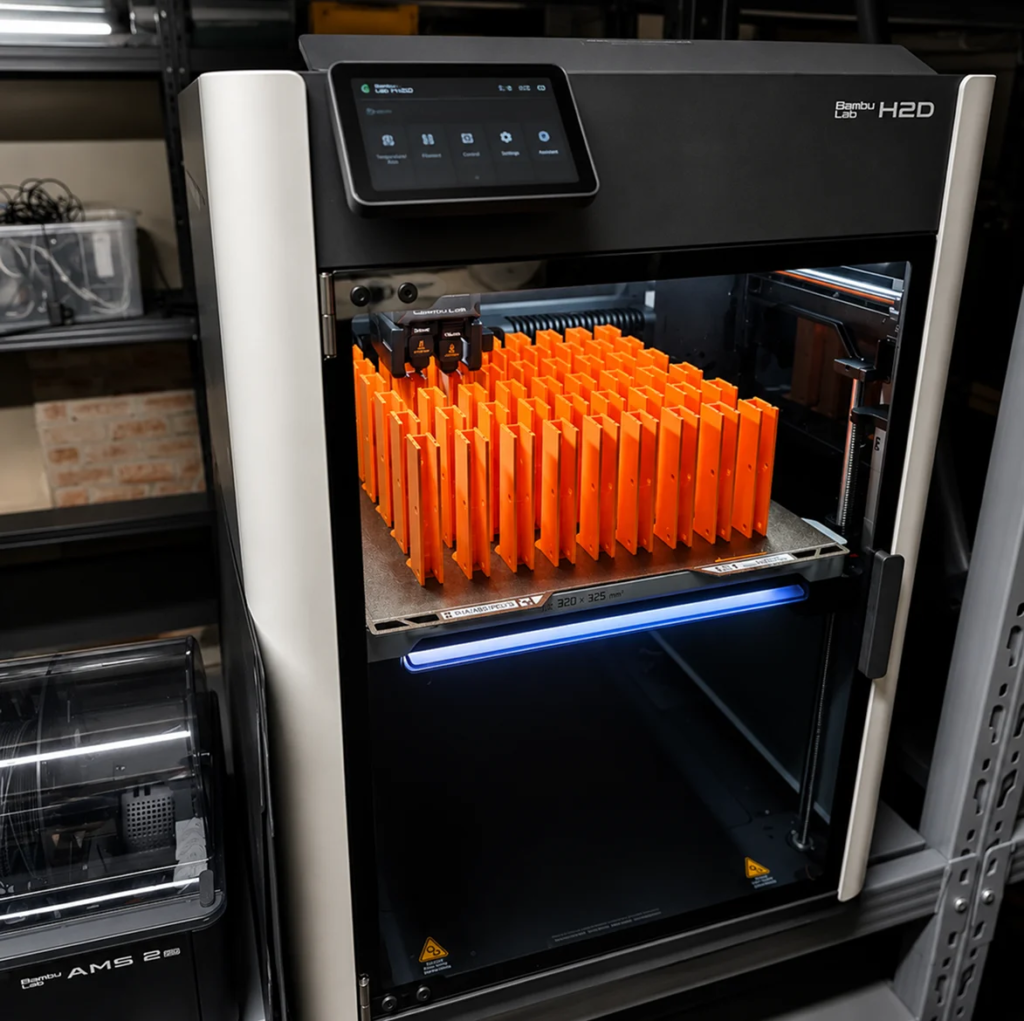
This makes 3D printing particularly useful for low- and medium-volume production. If demand is uncertain, investing thousands of dollars in a mold may not make sense when the same component can be printed directly.
Finding the Breakeven Point
For many manufacturers, the important question is not whether 3D printing is cheaper than injection molding. It is when one becomes cheaper than the other.
A good example comes from a case study conducted by FormLabs about development of the Form Cure L. Engineers needed a turntable gear to rotate the machine’s large curing platform. The gear included a chamfered central hole that needed to grip the central peg tightly enough to transfer the required rotational force.
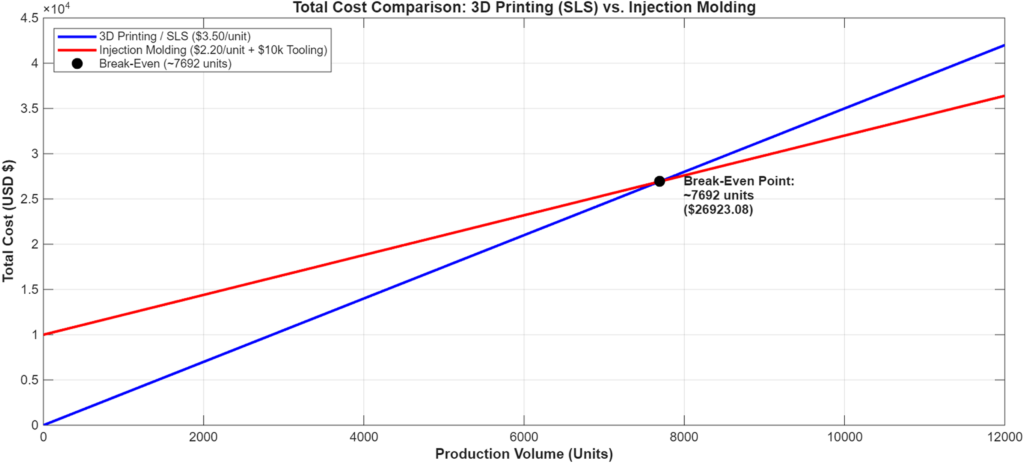
Producing this geometry with conventional injection molding would have required a two-part mold. The estimated tooling cost was around US$10,000.
Instead of changing the design to make it easier to mold, the engineers used Selective Laser Sintering (SLS) with Nylon 12. The gear could be produced directly as a single component, without manufacturing a dedicated mold.
The printed part cost approximately US$3.50 per unit, compared with around US$2.20 for an injection-molded part. At first, injection molding appears to be the obvious choice because of its lower unit cost. But the US$10,000 tooling investment changes the calculation.
At roughly 8,000 units, injection molding would begin to make more economic sense. Below that volume, the SLS process offered the lower overall cost because there was no tooling investment to recover.
As Robin Brockötter of Protolabs explains,
“3D printing can now start producing more and more parts before injection molding becomes cheaper.”
The production speed was also significant. A single SLS build could reportedly produce 374 gears in around 33 hours. With repeated builds, production could reach thousands of components per week.
The example shows why industrial 3D printing is no longer limited to prototypes. For products that are needed in relatively small quantities, or where future demand is difficult to predict, printing the parts directly can be a practical alternative to investing in tooling.
For the entire case study
Ready to Bring Your Ideas to Life?
Upload your model and get an instant quote
High quality , Fast delivery