3D Printing VS. Injection Molding

Why Is Industry Turning to 3D Printing?

3D Printing offers range of advantages, One of the biggest advantages is design freedom.
Designing Parts That Are Difficult to Mold
One of the biggest differences between the two technologies is design freedom.
Injection molding places several constraints on the geometry of a part. Draft angles are normally required so the part can be removed from the mold, wall thickness needs to be controlled to reduce warping, and undercuts can require additional tooling such as slides or lifters.
3D printing does not have the same mold-release requirements.
Industrial processes such as Fused Deposition Melting (FDM) and Stereolithography (SLA) build the part directly from a digital model. This makes it possible to produce internal channels, hollow sections, lattices, and other complex geometries that would be difficult or expensive to produce with conventional tooling.

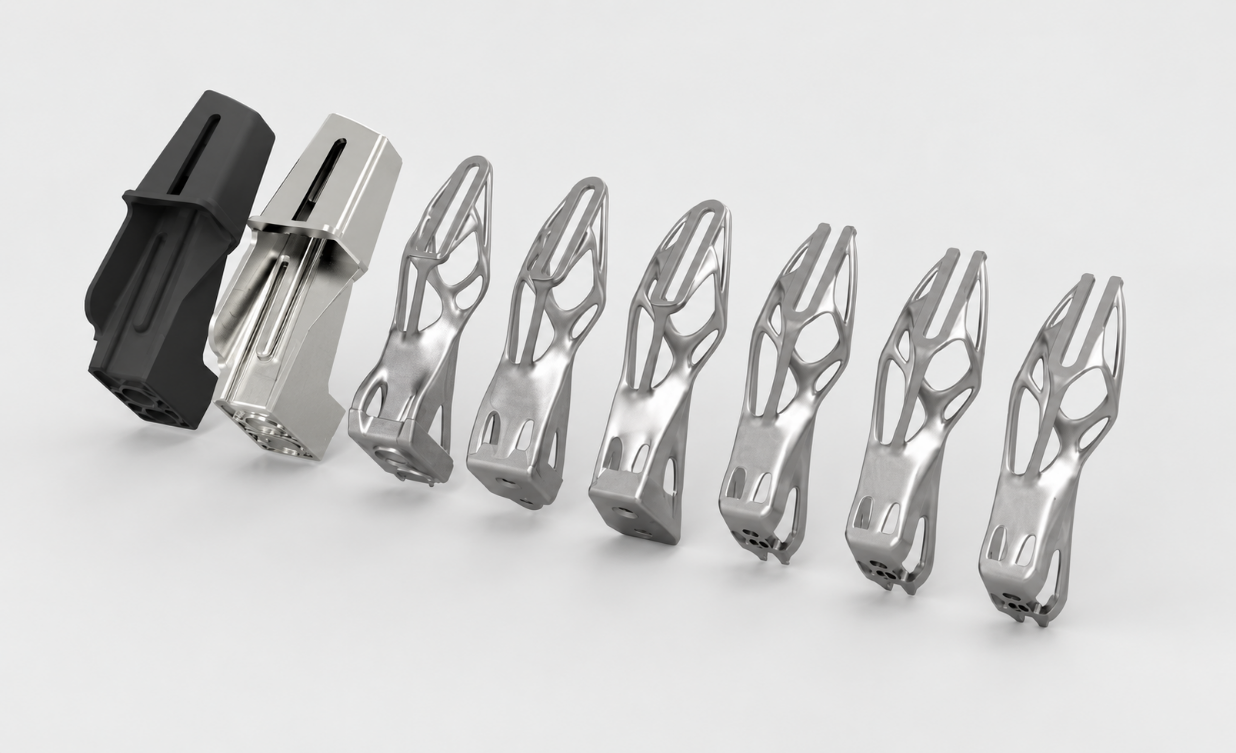
The difference becomes even more useful when engineers redesign a component specifically for additive manufacturing.
Topology optimisation, for example, allows material to be removed from areas where it contributes little to the structural performance of the part. Lattice or honeycomb structures can also be used to reduce weight while maintaining the required strength.
The result is not simply a molded part made by a different process. It can be a fundamentally different design.

There is also a supply-chain advantage. Some manufacturers use 3D printing to reduce their dependence on overseas suppliers and limit the impact of global supply-chain disruptions. Around 9% of manufacturers reportedly choose 3D printing for this reason. In 2024, a printer was donated to the Juan Fernandez islands, allowing a remote community to print replacement parts locally rather than waiting for expensive imports.

Peed is another factor. A prototype can potentially be printed and delivered within 24 to 72 hours. Developing a mold, on the other hand, can take several weeks before the first production parts are available.

So, Which One Is Better?
There is no single winner between 3D printing and injection molding.
For large, predictable production runs, injection molding is usually the more economical option. Once the tooling cost has been covered, its low unit cost and fast cycle times make it well suited to mass production.

3D printing becomes more attractive when production volumes are lower, designs are complex, or parts need to be available quickly. It also gives manufacturers the flexibility to change a design without having to manufacture a completely new mold.

The most useful way to look at the two technologies is therefore not as competing processes, but as different tools for different production requirements. The breakeven point depends on the part, the volume, the tooling cost, and how quickly the manufacturer needs to respond to changes in demand.

Ready to Bring Your Ideas to Life?

Upload your model and get an instant quote
High quality , Fast delivery

Contact Us

Contact Us

Get in touch


Scroll to Top